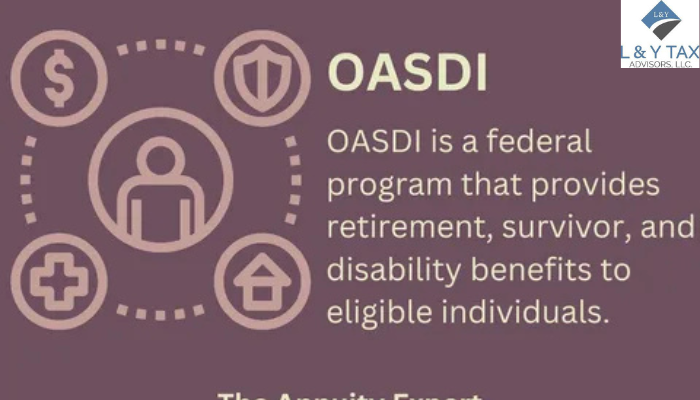

Do you know what is OASDI tax? The federal payroll tax that finances the Social Security program is the Old-Age, Survivors, and Disability Insurance (OASDI) tax, which is also sometimes called the Social Security tax.
The following can benefit from the OASDI tax:
- Retirees
- Disabled individuals
- Survivors of deceased workers
An Insight into OASDI Tax
The majority of US workers must pay the OASDI tax. In 2025, the OASDI tax percentage will be:
- 6.2% on the gross income of the employees
- 6.2% on the gross income of the employers
- 12.4% on the gross income of self-employed persons
Read: What is a VAT number in the US?
What is OASDI Tax Rate in 2025?
The highest income subject to the OASDI tax has been raised to $176,100, up from $168,600 in 2024. This means:
Employees
Maximum contribution of $10,918.20 (6.2% of $176,100).
Employers
Employers will also contribute $10,918.20 per employee.
Self-Employed
Maximum contribution of $21,836.40 (12.4% of $176,100)
Earnings above $176,100 are not subject to the OASDI tax but remain subject to Medicare taxes, which have no income cap.
Read: What is an industry accountant?
Is OASDI Tax Mandatory?
Under the Federal Insurance Contributions Act (FICA), the OASDI tax is a mandatory obligation for the majority of the American workforce.
Participation is not elective. The Internal Revenue Service (IRS) requires employers to withhold these funds automatically from an employee’s gross wages. This statutory requirement ensures a consistent revenue stream for the Social Security Trust Funds.
Most private-sector employees are covered. But, mandatory participation serves as a collective social insurance mechanism. Failure to comply with these withholding requirements leads to significant penalties for employers and complications for workers seeking to accrue the necessary credits for future benefit eligibility.
Who Is Exempt from OASDI Tax?
The majority of workers are subject to the OASDI tax. However, several categories are exempt:
- Members of particular religious groups who adamantly reject public insurance.
- Non-resident aliens include students on certain visas or foreign government workers.
- Some employees of the state and municipal governments are covered under alternative retirement plans.
- Self-employed individuals who make less than $400 per year
Read: Can a CPA be a registered agent?
Importance of OASDI Contributions
To get Social Security credits, you must contribute to the OASDI program. With a maximum of four credits annually, one credit is awarded for every $1,810 salary in 2025.
To be eligible for retirement benefits, one must earn 40 credits, equal to ten years of employment.
Recent Changes to OASDI Tax and Future Projections
Based on legislation in the past few years, there have been important changes to the OASDI tax provisions. Social Security’s maximum taxable earnings in 2025 were adjusted to $176,100 (up from the prior limit of $137,700). This increase is a part of an ongoing review to adjust for inflation and fluctuations in the national economy. The OASDI tax rate of 6.2% on employees and employers continues to apply, but higher income is not taxed above the cap. This correction is intended to keep the Social Security program on a sound footing by providing for its continued funding of payments to those individuals who are retired, disabled, or are survivors of deceased workers.
In the future, adjustments to the Social Security program could be made in response to demographic changes, as a larger number of retirees will claim benefits compared with the smaller number of workers who would pay into the fund. It’s projected that the program will run out of money eventually, likely necessitating policy shifts in tax rates or benefit levels to keep both funds solvent. Keeping up with changes is essential for long-term financial planning.
OASDI Tax on Non-Standard Income
The OASDI tax applies uniformly to wages. But its treatment of non-standard income is misunderstood.
For instance, Supplemental Unemployment Benefits from a company-financed trust are typically subject to Social Security tax withholding, as the IRS considers them wages.
Conversely, bona fide gifts from an employer, detached from service, are generally exempt, preserving their non-compensatory nature.
Self-Employment and Estimated Payments
For self-employed individuals, the 12.4% OASDI tax is not simply paid at year-end. The IRS mandates quarterly estimated tax payments if your combined income and self-employment tax liability exceeds $1,000 annually. This “pay-as-you-go” system prevents a large, year-end burden and potential underpayment penalties, calculated via Schedule SE and reported on Form 1040-ES.
The Role of Tax Deposits for Employers
Employer compliance extends beyond simply calculating the 6.2% share. Federal law requires semi-weekly or monthly tax deposits via the Electronic Federal Tax Payment System (EFTPS). The deposit schedule is rigid, based on a lookback period of prior tax liability. A failure to correctly time and remit these deposits triggers steep IRS failure-to-deposit penalties, independent of the underlying tax obligation.
Navigating Exemptions and Special Cases
Verifying exempt status requires strict documentation. Qualifying non-resident alien workers on F-1 or J-1 visas must provide substantial proof, as their exemption ceases if they become resident aliens for tax purposes. This complexity extends to all income types, raising questions, like how do strippers pay taxes on tips, which are fully taxable wages subject to both income and OASDI withholding when reported to an employer. Accurate record-keeping is paramount to avoid future benefit shortfalls.
The Bottom Line
Effective financial planning requires understanding what is OASDI tax and its consequences. Completing yearly modifications guarantees adherence and facilitates retirement planning.
Contact L&Y Tax Advisor for the best management of your personal and professional tax and financial matters!