
Tax planning requires a precise knowledge about the interactions between state-level obligations and federal filings. In recent years, one of the most significant shifts involved the limitations placed on state and local tax offsets. High-income earners looking to optimize their financial position must navigate such rules. Comprehending what are SALT deduction caps helps you identify potential tax-saving opportunities to stay compliant with current federal mandates.
What is a SALT Deduction?
The SALT deduction allows taxpayers who itemize to subtract certain taxes paid to state and local governments from their gross income. Traditionally, this included property taxes along with either income or sales taxes.
By leveraging SALT deductions, individuals could historically reduce their federal taxable income significantly. They used to ensure that they were not paying federal taxes on money already directed toward local governance. Blueprint Advisors ensures that such entries are recorded with technical precision.
What is the History of SALT Deduction?
The state and local tax deduction has been part of the U.S. tax code since the first federal income tax in 1913. Its purpose was simple: stop the government from taxing money you already paid to your state or town.
For over a century, there was no limit on how much you could deduct. That changed in 2017 when the Tax Cuts and Jobs Act introduced a $10,000 ceiling. This sudden cap is exactly what people mean when they ask “What are SALT deduction caps?” It was set to expire after 2025. And now that it has, the deduction is once again unlimited for those who itemize.
Read: What gives the US government the power to collect taxes?
What is a SALT Cap?
A ‘cap’ refers to the maximum dollar amount a taxpayer can claim for specific deductions on their federal return. It was established by the Tax Cuts and Jobs Act (TCJA). This ceiling was designed to broaden the tax base.
Taxpayers can still track their local contributions. The federal government only recognizes a portion of those payments for deduction purposes.
What are SALT Deduction Caps?
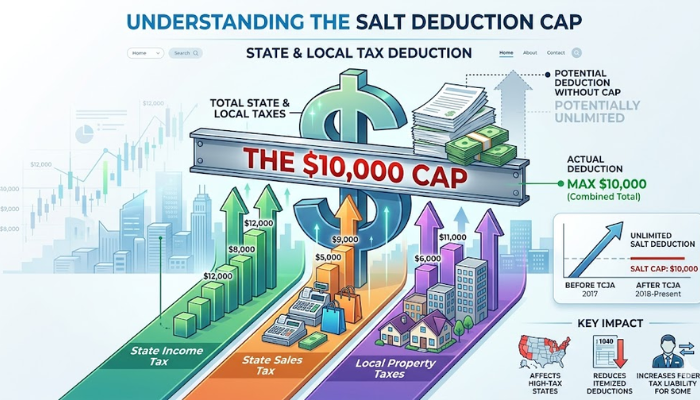
The current regulatory framework dictates a strict USD 10,000 limit (USD 5,000 if married filing separately) on the total amount of state and local taxes that can be deducted. This figure is an aggregate. It means that it combines your:
- Real estate taxes
- Personal property taxes
- Either state income or sales taxes
When analyzing what are SALT deduction caps, recognize that any amount paid above this USD 10,000 threshold provides no federal tax benefit.
To solve the problem of ‘lost’ deductions, many states have enacted Workaround Pass-Through Entity (PTE) taxes. These allow business owners to pay state taxes at the entity level, which are then deductible as business expenses without being subject to the individual USD 10,000 limit. To utilize these strategies, you need deep client insights to ensure the structure aligns with state and federal legality.
What is the SALT Deduction Example?
Consider a homeowner who pays USD 8,000 in property taxes and USD 7,000 in state income taxes, totaling USD 15,000. Under the current rules regarding what are SALT deduction caps, this individual can only deduct USD 10,000 on their Schedule A. The remaining USD 5,000 is effectively ‘disallowed’ which increases their federal taxable income compared to pre-2018 regulations.
What Does SALT Do For My Taxes?
The primary function of SALT deduction is to prevent double taxation. The federal government acknowledges the monetary burden on citizens by local jurisdictions by allowing a portion of state payments to be deducted.
What is Included in SALT Deduction?
The deduction includes three main categories:
- State and local income taxes (or sales taxes, but not both)
- Real estate taxes (on property you own)
- Personal property taxes (such as vehicle registration fees based on value).
These must be taxes imposed on you and paid during the tax year to be eligible for the itemized deduction.
How Does the SALT Deduction Work?
This deduction only applies if you choose to itemize your deductions – not taking the standard deduction. If your total itemized deductions exceed the standard deduction for your filing status, it is monetarily beneficial to claim them.
Who Benefits From SALT Deduction?
SALT deductions is beneficial for:
- Taxpayers in high-tax jurisdictions
- Taxpayers with high-value real estate
However, due to the USD 10,000 ceiling, many middle-to-high-income earners find that the standard deduction now provides a greater benefit than itemizing, unless they have significant other deductible expenses.
What is the SALT deduction for 2026?
In order to understand what the SALT deduction for 2026 means, one must acknowledge a major shift in tax policy. For years, taxpayers wondering whats salt tax rules applied to their state and local payments could rely on a strict $10,000 ceiling introduced by the Tax Cuts and Jobs Act, which would expire after 2025, as the SALT Cap was known by.
Now that this sunset has taken effect, what is salt deduction for 2026 looks like differs: itemizing taxpayers can once more deduct all state and local tax payments without regard to previous limitations, which includes property, personal property taxes, as well as either state income or sales taxes. When reviewing what amount has been spent throughout the year for salt taxes you owe, be mindful that what are salt deductions can significantly lower federal taxable income compared to recent years.
Conclusion
Stay informed regarding what are SALT deduction caps. Prioritise updated knowledge for efficient wealth management. The USD 10,000 limit pos
Tax planning requires a precise knowledge about the interactions between state-level obligations and federal filings. In recent years, one of the most significant shifts involved the limitations placed on state and local tax offsets. High-income earners looking to optimize their financial position must navigate such rules. Comprehending what are SALT deduction caps helps you identify potential tax-saving opportunities to stay compliant with current federal mandates.
What is a SALT Deduction?
The SALT deduction allows taxpayers who itemize to subtract certain taxes paid to state and local governments from their gross income. Traditionally, this included property taxes along with either income or sales taxes.
By leveraging SALT deductions, individuals could historically reduce their federal taxable income significantly. They used to ensure that they were not paying federal taxes on money already directed toward local governance. L&Y Tax Advisors ensures that such entries are recorded with technical precision.
What is the History of SALT Deduction?
The state and local tax deduction has been part of the U.S. tax code since the first federal income tax in 1913. Its purpose was simple: stop the government from taxing money you already paid to your state or town.
That changed in 2017, when the Tax Cuts and Jobs Act (TCJA) introduced a $10,000 ceiling. This cap was originally set to expire after 2025. However, rather than reverting to an unlimited deduction, the One Big Beautiful Bill Act (OBBBA), signed into law in July 2025, replaced the TCJA cap with a new, significantly higher limit: $40,000 for 2025, rising to $40,400 for 2026 ($20,200 for married filing separately). This elevated cap is scheduled to increase roughly 1% annually through 2029, and phases down for taxpayers with modified adjusted gross income (MAGI) above $505,000. Absent further legislation, the cap is set to revert to $10,000 starting in 2030.
For 2026, the SALT deduction cap is $40,400 for most filers ($20,200 for married filing separately) — a substantial increase from the prior $10,000 limit, though still not unlimited. High-income filers should be aware of the MAGI phase-down, which begins reducing the deduction above $505,000 and can bring it back down toward the $10,000 floor for the highest earners.
Read: What gives the US government the power to collect taxes?
What is a SALT Cap?
A ‘cap’ refers to the maximum dollar amount a taxpayer can claim for specific deductions on their federal return. It was established by the Tax Cuts and Jobs Act (TCJA). This ceiling was designed to broaden the tax base.
Taxpayers can still track their local contributions. The federal government only recognizes a portion of those payments for deduction purposes. Comprehending this limit is vital to know your precise VAT number or other business-related tax identifiers that might be impacted by overall liability.
What are SALT Deduction Caps?
The current regulatory framework dictates a strict USD 10,000 limit (USD 5,000 if married filing separately) on the total amount of state and local taxes that can be deducted. This figure is an aggregate. It means that it combines your:
- Real estate taxes
- Personal property taxes
- Either state income or sales taxes
When analyzing what are SALT deduction caps, recognize that any amount paid above this USD 10,000 threshold provides no federal tax benefit.
To solve the problem of ‘lost’ deductions, many states have enacted Workaround Pass-Through Entity (PTE) taxes. These allow business owners to pay state taxes at the entity level, which are then deductible as business expenses without being subject to the individual USD 10,000 limit. To utilize these strategies, you need deep client insights to ensure the structure aligns with state and federal legality.
What is the SALT Deduction Example?
Consider a homeowner who pays USD 8,000 in property taxes and USD 7,000 in state income taxes, totaling USD 15,000. Under the current rules regarding what are SALT deduction caps, this individual can only deduct USD 10,000 on their Schedule A. The remaining USD 5,000 is effectively ‘disallowed’ which increases their federal taxable income compared to pre-2018 regulations.
What Does SALT Do For My Taxes?
The primary function of SALT deduction is to prevent double taxation. The federal government acknowledges the monetary burden on citizens by local jurisdictions by allowing a portion of state payments to be deducted.
This interaction is a key component in determining what is tax yield for the federal government versus the retained earnings of the individual taxpayer.
What is Included in SALT Deduction?
The deduction includes three main categories:
- State and local income taxes (or sales taxes, but not both)
- Real estate taxes (on property you own)
- Personal property taxes (such as vehicle registration fees based on value).
These must be taxes imposed on you and paid during the tax year to be eligible for the itemized deduction.
How Does the SALT Deduction Work?
This deduction only applies if you choose to itemize your deductions – not taking the standard deduction. If your total itemized deductions exceed the standard deduction for your filing status, it is monetarily beneficial to claim them.
Who Benefits From SALT Deduction?
SALT deductions is beneficial for:
- Taxpayers in high-tax jurisdictions
- Taxpayers with high-value real estate
However, due to the USD 10,000 ceiling, many middle-to-high-income earners find that the standard deduction now provides a greater benefit than itemizing, unless they have significant other deductible expenses.
What is the SALT deduction for 2026?
In order to understand what the SALT deduction for 2026 means, one must acknowledge a major shift in tax policy. For years, taxpayers wondering whats salt tax rules applied to their state and local payments could rely on a strict $10,000 ceiling introduced by the Tax Cuts and Jobs Act, which would expire after 2025, as the SALT Cap was known by.
Now that this sunset has taken effect, what is salt deduction for 2026 looks like differs: itemizing taxpayers can once more deduct all state and local tax payments without regard to previous limitations, which includes property, personal property taxes, as well as either state income or sales taxes. When reviewing what amount has been spent throughout the year for salt taxes you owe, be mindful that what are salt deductions can significantly lower federal taxable income compared to recent years.
Conclusion
Stay informed regarding what are SALT deduction caps. Prioritise updated knowledge for efficient wealth management. The USD 10,000 limit poses a challenge. But, strategic planning and entity-level adjustments help mitigate the impact. Proper documentation and a proactive approach ensure that you remain within the bounds of the law.
es a challenge. But, strategic planning and entity-level adjustments help mitigate the impact. Proper documentation and a proactive approach ensure that you remain within the bounds of the law.