
If you own land with oil, gas, or minerals, you’ve likely come across the phrase what is the severance tax. It’s a state‑level charge that can hit your royalty checks or operating profits before you see a dollar.
Many landowners and small operators get caught off guard because they focus only on federal income tax. This guide cuts through the confusion, showing you how the tax works, where exemptions hide, and how to keep your cash flow healthy without surprises.
Severance Tax Meaning
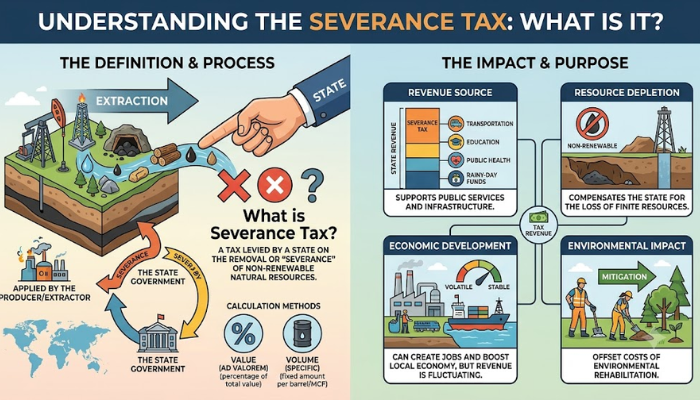
When you dig into natural resource royalties, one of the first questions you’ll ask is what is the severance tax in simple language. It’s not a property tax on the land itself; it’s a privilege tax on the activity of removing—or “severing”—non‑renewable resources from the ground. Think of it as a fee paid for permanently taking something valuable away. That fee is often based on the volume or market value of what you extract, and it goes straight to the state where the drilling or mining happens.
What is the Severance Tax?
A severance tax is an excise tax imposed by states on the extraction—or “severing”—of nonrenewable natural resources from the ground, including oil, natural gas, coal, uranium, and timber.
The severance tax is typically assessed according to either the volume or the market value of the resource that has been extracted. This tax is not refundable. It is usually reported separately from income tax. So, missing a filing can lead to penalties even if your well is losing money.
What is the Severance Tax in the US?
In the United States, severance taxes are purely state‑level tools. Each resource‑rich state sets its own rules, rates, and definitions.
For example, Texas imposes a tax on oil and natural gas production, while Wyoming leans heavily on coal and mineral levies. Some states use the revenue to fund public schools, environmental cleanup, or infrastructure repairs in the very counties where extraction occurs.
Because there’s no federal severance tax, understanding your specific state’s framework is where most mistakes happen.
Why is it Called Severance Tax?
The name itself answers the question of what is the severance tax really about: you are severing a finite resource from the earth forever. Unlike an income tax that touches ongoing earnings, this levy acknowledges that once the resource is gone, it can’t be replaced. That is why states designed it as a separate, upfront cost—to capture value for the community before the mineral wealth disappears. The word “severance” tells you exactly when the tax obligation is born: the moment extraction happens.
Severance Taxes By State
Rates and structures vary dramatically. Some states charge a flat percentage of market value, while others use a graduated scale based on production volume.
A handful of states with minimal extraction have no severance tax at all. If you operate across state lines, you need to track each jurisdiction’s filing deadlines separately. On top of that, if your business ever expands into selling goods internationally, you may also need a VAT number to handle value‑added tax obligations overseas—a completely different animal but one that can affect your overall compliance picture.
How Severance Tax Works and Who It Affects?
To truly grasp what is the severance tax, you need to see how it flows through the supply chain. Most commonly, the operator pays the tax and then deducts it from royalty checks sent to mineral owners. Landowners who lease their rights therefore indirectly bear the cost. Pipeline companies, first purchasers, and even royalty trusts can feel the impact because the tax reduces the net revenue that gets distributed. This means even if you never run a drill, your mailbox money shrinks when severance rates rise.
Severance Tax Incentives and Exemptions
States often sweeten the deal with breaks that lower the effective rate. Low‑producing stripper wells, enhanced recovery projects, and new discovery wells may qualify for reduced rates or temporary exemptions.
Some states also exempt the first few barrels of daily production. But here’s a common point of confusion: even if you get a severance tax break do you have to pay property taxes on land you own? Yes—property taxes are based on land value, separate from the mineral extraction privilege, so you still carry that annual bill unless a specific agricultural or homestead exemption applies.
What is the Contribution of Severance Tax to State Revenue?
In resource‑dependent states, severance taxes can fund a huge chunk of the budget. Alaska, for instance, has used oil severance revenue to build permanent savings funds that pay dividends to residents. Wyoming channels coal and natural gas taxes directly into school construction. This means the tax is not just a nuisance—it’s a politically protected revenue stream. When commodity prices crash, state budgets tremble, and lawmakers rarely eliminate the tax entirely; they might only tweak rates temporarily.
How to Calculate Severance Tax by State?
You start by determining the taxable base—usually gross production value minus allowed deductions like transportation or processing costs. Then, apply the rate set by your specific tax district, which can change based on county or even township boundaries.
For example, a barrel of oil might be taxed at 5% of its market price, but that percentage could be higher if the well sits in a special school‑fund district.
Always check the state revenue department’s current rate sheets, because rate changes can take effect at the start of a fiscal quarter.
The Bottom Line
Now that you have a clear picture of what is the severance tax, you can see it’s more than a line‑item deduction—it’s a state‑specific cost that shapes whether a lease is truly profitable. From understanding exemptions to factoring it into royalty division, getting this right protects your earnings.
L&Y Tax Advisors helps mineral owners, operators, and investors navigate these layered rules so you don’t leave money on the table or face a surprise audit.