
Picture yourself at the gas station. You fill up the tank and notice the price is higher than last year. Part of that increase can come from a government policy designed to protect the planet. So, what is the meaning of carbon tax? It is a fixed amount levied on the carbon content of fuels like:
- Coal
- Oil
- Natural gas
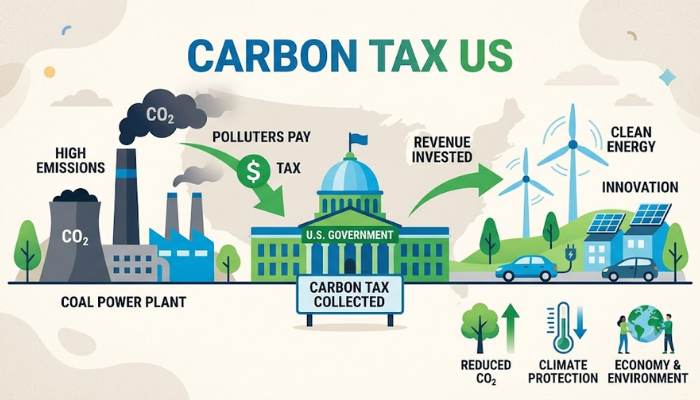
The goal of carbon taxation is to make polluting activities more expensive. It compels people and businesses to naturally choose cleaner options.
What exactly is Carbon Tax?
A carbon tax is a direct price on each ton of carbon dioxide (CO₂) emitted into the air. It is like a “pollution price tag.” When power plants, factories, and vehicles burn fossil fuels, they pay a fixed amount per ton of emissions. This system works because it uses market forces: if “unhealthy” energy costs more, everyone searches for cheaper, cleaner ways to run such tasks.
For a deeper dive into how such policies affect your tax planning, explore carbon tax insights that connect global rules to everyday finances.
What is the Meaning of Carbon Tax in Economics?
Economists describe it as a Pigouvian tax – a charge designed to fix a “negative externality.” In simple language, pollution hurts everyone. But without a tax, polluters do not pay for that damage.
Carbon tax forces the price of goods to reflect their true social and environmental cost. When a factory pays $40 for every ton of CO₂ it emits, it has a strong incentive to innovate, reduce waste, and switch to renewables. The tax does not dictate how to cut emissions. It makes polluting costlier and lets creativity do the rest.
What is an Example of a Carbon Tax?
A simple example is a charge on each ton of coal burned. If a power station emits 100,000 tons of CO₂ per year and the tax rate is $50 per ton, that station owes $5 million. These rates vary. But the principle remains consistent: the more you pollute, the more you pay.
With tax advisor services, you will understand that carbon costs can be managed with
- Credits
- Efficiency upgrades
- Changes in solar and wind energy
What are the Government Strategies in Carbon Taxing?
Governments rarely just set a tax and walk away. They use thoughtful designs:
- Starting with a low rate that rises over time.
- Offering rebates to low-income households.
- Recycling the money through reduced income taxes.
Some also require emitters to register, much like a business needs a VAT number to handle value-added tax. A revenue-neutral strategy helps build public support. The aim is to cut emissions without punishing families who can least afford higher energy bills.
Countries With Carbon Tax
More than 30 countries now impose a direct carbon tax, and dozens more use related carbon-pricing mechanisms like emissions trading systems. In these countries, what is the meaning of carbon tax becomes a daily reality: it shapes:
- Electricity costs
- Transportation expenses
- The price of food
The following countries currently use carbon taxes as key climate tools:
Sweden
Singapore
South Africa
Uruguay (one of the world’s highest carbon tax rates)
Note: Canada repealed its federal consumer carbon tax in April 2025, though industrial carbon pricing for large emitters remains under a separate framework.
Sweden’s carbon tax rate is one of the highest globally, exceeding $130 per ton of CO₂. Yet its economy has continued to grow.
If you work with a tax preparer Houston TX, comprehend international carbon taxes if your business touches global supply chains. The lesson is clear: carbon pricing is no longer a rare experiment. It is a worldwide shift.
Who Needs to Pay Carbon Tax?
The tax hits fossil fuel producers, importers, or large industrial emitters. However, the costs rarely stop there.
As companies pay more for fuel and raw materials, they raise their prices. This is how the burden trickles down to households. So, what is the meaning of carbon tax for an individual? It means slightly pricier:
- Electricity
- Gasoline
- Goods
How Carbon Taxes Impact Emissions and the Economy?
When you ask what is the meaning of carbon tax for the planet and pockets, the evidence is encouraging. Studies show that countries with carbon taxes have cut emissions by 10–25% over time without crashing their economies. The tax pushes innovation in
- Electric vehicles
- Renewable power
- Energy-efficient appliances
On the economic side, a wisely designed carbon tax can even boost employment in green sectors. The key is what governments do with the revenue. If they lower other taxes or invest in public transit, both the environment and the economy can win.
Carbon Tax Pros and Cons
Like any powerful tool, the carbon tax has two sides.
Pros of Carbon Tax
- Reduced air pollution.
- Encouraging clean technology.
- Generating government revenue to fund schools, healthcare, or tax cuts.
- Simple concept implementation: pollute less, pay less.
Cons of Carbon Tax
- Higher energy costs hurt low-income families the most.
- Carbon leakage: Industries may move to countries without such taxes.
Carbon tax is a pragmatic way to divert the economy towards a cleaner future. But it must include smart protections for vulnerable people to be fair and effective.
The Bottom Line
Now you have a solid grasp on what is the meaning of carbon tax. It is far more than an environmental slogan. It is a practical, widely used strategy that affects energy bills, product prices, and government budgets.
Whether you run a business, freelance, or try to manage your household expenses, this knowledge helps you plan better. If you ever feel tangled in tax questions of any kind, Blueprint Advisors can guide you toward clarity and peace of mind.