

When navigating asset management, financial reporting, or corporate tax planning, understanding the true worth of your real estate is critical. But what is property valuation exactly, and how does it directly affect your financial health?
At Blueprint Advisors, we recognize that accurate asset assessments form the bedrock of strategic financial decisions, ensuring you never overpay on taxes or misrepresent your balance sheet.
What is Property Valuation and Why is it Important?
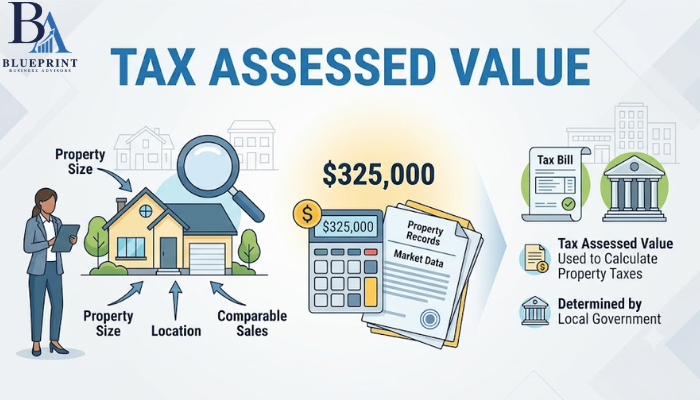
Stripping away the complex jargon, an appraisal determines the fair market value of a piece of real estate based on its condition, location, and economic trends.
Knowing how to get a property valuation allows business owners and individuals to establish an accurate financial baseline. This process is essential for robust business tax advisory because it dictates
- Depreciation schedules
- Asset allocations
- Potential capital gains liabilities
Why and When Might I Need My Property Valued?
There are several pivotal moments when determining asset worth becomes a non-negotiable requirement. Whether you are facing a property tax appeal, structuring an estate, or navigating a corporate merger, knowing what is property valuation helps safeguard your investments from costly inaccuracies.
If you want to know how to check valuation of property during these transitions, it involves aligning historical acquisition costs with current fair market realities to avoid compliance penalties.
What is Property Valuation Online?
Many platforms offer instant algorithmic estimates, often referred to as automated valuation models (AVMs). While these digital tools provide a quick snapshot, relying solely on them to determine what is the valuation of a property can be highly risky for official tax filings. They lack the nuanced inspection required to understand how to calculate property valuation for complex, high-value portfolios or unique commercial structures.
What Does a Property Valuation Include?
A comprehensive assessment goes far beyond a single final number on a page. To fully comprehend what is property valuation, look at the detailed breakdown of the report, which includes structural analysis, zoning verifications, and localized market comps.
For specialized assets, an industrial property valuation will additionally include machinery impacts, environmental compliance, and operational utility, defining exactly what is a property valuation in a commercial context.
What is Property Valuation Example?
To see this in action, imagine a company owning a 10,000-square-foot commercial warehouse originally purchased for two million dollars. If the local market surges or the facility undergoes significant capital improvements, the historical book value no longer reflects reality, showing why what is a property valuation matters. An updated report might reveal its current worth is three million dollars, adjusting the company’s equity and tax depreciation basis accordingly.
How to Check Valuation of Property?
Fulfilling your regulatory and financial obligations requires a systematic approach to verifying asset figures. To properly execute how to check valuation of property, you must follow a clear sequence:
Gather Documentation
Compile deeds, historical purchase receipts, and recent renovation invoices.
Review Local Market Trends
Monitor recent sales of comparable properties in your immediate area.
Align with Financial Records
Ensure these updated asset values are meticulously synchronized with your QuickBooks & bookkeeping services to maintain flawless, audit-ready financial statements.
This step-by-step process ensures that you accurately capture what is property valuation across all operational metrics.
How to Calculate Property Valuation?
Determining numerical worth demands a deep dive into specific financial formulas and market metrics. When learning how to calculate property valuation, professionals typically follow these core steps:
Determine Net Operating Income (NOI)
Calculate the property’s annual gross income minus all operating expenses.
Apply the Capitalization Rate
Divide the NOI by the current market cap rate to find the baseline value.
Adjust for Market Variables
Factor in depreciation, vacancy rates, and inflation impacts.
Partnering with a dedicated small business accounting firm in The Woodlands, Texas ensures that these calculations remain mathematically sound, objective, and fully compliant with GAAP and USPAP (Uniform Standards of Professional Appraisal Practice) standards that govern what is property valuation.
What are the Types of Property Valuation?
Assessments are broadly categorized depending on the specific nature and operational intent of the real estate involved. The main categories include:
Residential Appraisals
Focused on single-family homes, townhouses, and multi-family apartments based on consumer demand.
Commercial Appraisals
Centered on office buildings, retail spaces, and hotels, relying heavily on income-generating potential.
Specialized Industry Appraisals
Delving deeper into what is property valuation reveals that segments like industrial property valuation require unique parameters, focusing on logistics access, ceiling heights, and heavy-duty manufacturing capabilities.
What are the Methods of Property Valuation?
Professional appraisers rely on three universally accepted methodologies published across leading financial publications, like the Journal of Property Investment & Finance:
The Sales Comparison Approach
Compares the target asset to recently sold properties with similar characteristics.
The Income Capitalization Approach
Values the property based on the future economic streams it is expected to generate.
The Cost Approach
Calculates the cost to replicate the structure from scratch, minus accumulated depreciation.
Mastering how to valuation of property requires selecting the exact methodology that matches the asset’s primary use. Once you determine the correct framework, discovering how to get a property valuation that stands up to regulatory scrutiny becomes a smooth, reliable process.
How to Valuations of Property Work?
The actual execution of an appraisal involves data collection, on-site inspection, and rigorous market reconciliation. Here is how the operational workflow unfolds:
Initial Inspection
An expert physically examines the site to grade structural integrity, wear, and unique upgrades.
Data Analysis
The valuer cross-references public records, zoning regulations, and macroeconomic shifts.
Final Reporting
A formal document is generated to support financial statements, loan applications, or tax strategies.
Understanding how to valuation of property work highlights the importance of matching physical assets with microeconomic data points. To ensure that what is the valuation of a property is legally defensible for tax deductions or financial audits, working alongside qualified CPAs The Woodlands TX guarantees that every data point satisfies strict regulatory standards.
The Bottom Line
Managing your real estate portfolio with precision requires embracing strategic, intent-driven financial insights. Knowing what is property valuation and how it influences your broader tax liabilities enables you to make proactive, defensive financial moves that protect your bottom line. Fulfill your compliance requirements and optimize your asset strategies by ensuring your valuations are handled by proven financial experts.