
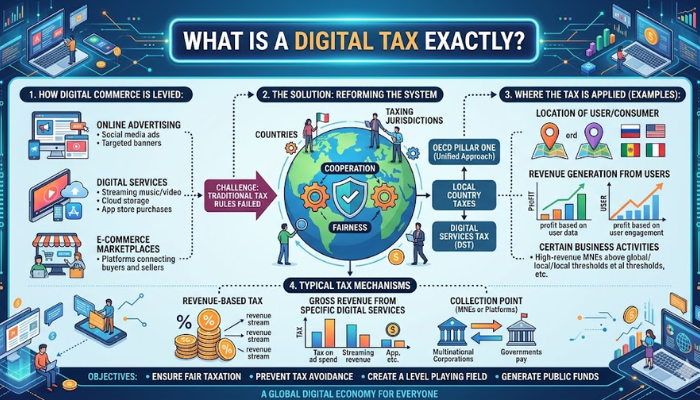

The rapid shift toward a borderless economy has left many business owners asking, what is a digital tax exactly? The answer is no longer just about software downloads. It now encompasses a complex web of ‘economic nexus’ and ‘digital asset’ reporting. For modern entrepreneurs, staying compliant means moving beyond simple data entry towards strategic validation of every online transaction.
What Does Going Digital Mean for Taxes?
‘Going digital’ implies that your tax obligations are triggered by where your customers are located, not where your office sits.
Authorities are increasingly focusing on ‘Digital Continuous Transactional Reporting’ (DCTR). This means that for every subscription or e-service sold, a digital footprint is created that tax departments can monitor in near real-time.
What is a Digital Tax Exactly?
So, what is a digital tax exactly?
Digital tax is a specialized levy applied to intangible goods and services, including
- SaaS
- Streaming
- Digital assets (like NFTs)
The IRS and various state authorities have tightened reporting requirements, such as the mandatory Form 1099-DA for digital asset brokers. This shift ensures that virtual wealth and online services are documented with the same rigor as physical real estate.
Digital Tax Example
Consider a business providing cloud-based project management software. Even without a physical storefront, selling to users in states like Maryland or cities like Chicago now triggers specific IT service taxes or ‘cloud computing’ levies. This can reach as high as 15%. This illustrates that your digital reach is now your primary tax gateway.
How Does a Digital Tax Work?
Modern systems operate through automated enforcement. But, what is a digital tax exactly in practice? It is an ecosystem where ‘withholding agents’ are considered:
- Payment gateways
- Online marketplaces
These intermediaries are now legally responsible for collecting and remitting taxes at the point of sale. They ensure that the government receives its share before the revenue even hits your business bank account.
How is Digital Tax Calculated?
Calculation is now a data-driven process. Most jurisdictions use ‘destination-based’ sourcing. It means that the tax rate is determined by the buyer’s
- IP address
- Billing zip code
To manage such shifting variables, L&Y Tax Advisors recommends integrating AI-driven accounting tools that validate customer locations and apply the correct local rates automatically to prevent costly audits.
The Bottom Line
Comprehending what is a digital tax exactly is the first step in protecting your firm’s financial future. Regulations continue to evolve with mandatory e-invoicing and stricter digital asset oversight. Proactive planning is your best defense. Align your operational reality with these modern compliance frameworks to ensure your business scales without friction.