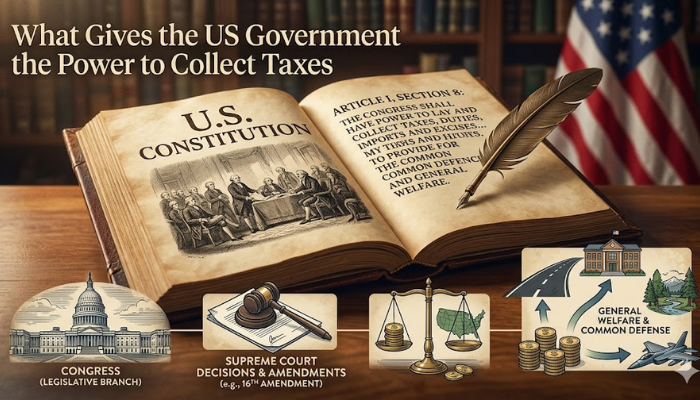

The answer is not hidden in dusty law books alone. It is written straight into the founding documents that shape our everyday financial life. Knowing this source of power helps you understand why filing returns, responding to notices, and paying what you owe are not just customs but legal duties backed by the highest law of the land.
Who Has the Power to Tax?
Congress holds the constitutional authority to lay and collect taxes. This means the legislative branch, not the president or the courts, designs the tax system.
To make administration practical, the IRS — under Treasury Department oversight — is organized into operating divisions based on taxpayer type (individuals, small businesses, large corporations, and tax-exempt entities) rather than geographic districts.
Collecting Taxes is What Type of Power?
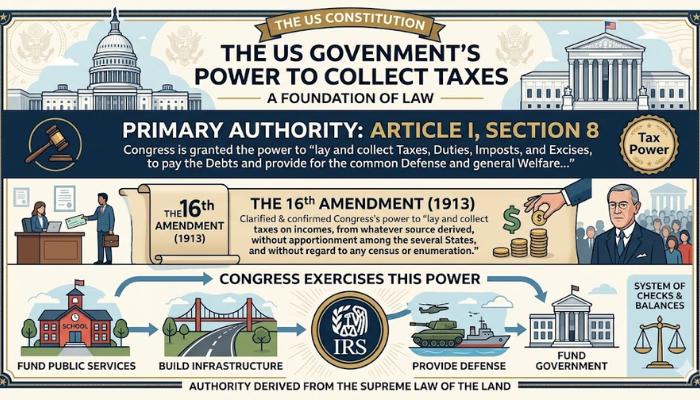
Collecting taxes is an enumerated power. The Constitution clearly lists it in Article I, Section 8. It is also a concurrent power because both federal and state governments can impose taxes.
The federal tax power is not hidden or assumed; it is written in black and white. This direct grant is what gives the US government the power to collect taxes legally. It is a sovereign power required for any government to function. Afterwards, the 16th Amendment expanded this power for income taxes without apportionment. So, tax collection sits firmly as a stated, shared authority, not an unlimited or secret privilege.
Read: What are business ethics?
What Gives the Government the Right to Tax Us?
That right flows from Article I, Section 8 of the Constitution, paired with the 16th Amendment’s income tax provision. When citizens accept this social contract, they also accept related obligations.
A common question that pops up is, do you have to pay property taxes on land you own? While federal law sets the income tax stage, property taxes typically come from state and local governments yet the constitutional backbone makes all taxation possible.
What Gives the US Government the Power to Collect Taxes?
Precisely, what gives the US government the power to collect taxes is the combination of the Taxing and Spending Clause and the 16th Amendment, which removed the apportionment barrier for income taxes. This legal framework empowers the IRS to:
- Issue rulings
- Audit returns
- Enforce payment
Without it, the modern tax collection system would have no foundation. And the government would lack the means to fund its operations.
What Gives the US the Right to Collect Taxes?
When you dig deeper into what gives the US government the power to collect taxes, you find that the 16th Amendment clarified Congress’s ability to tax incomes without dividing the burden by state population. This right is further cemented by Supreme Court decisions that consistently uphold the government’s broad taxing authority.
So the right to collect is not an arbitrary claim. It is a deliberate legal design that has been tested and confirmed over time.
Why Does the United States Government Collect Taxes?
Taxes fund roads, national defense, healthcare, and education. But the legal engine that makes it possible is what gives the US government the power to collect taxes – a constitutional permission slip that turns civic duty into enforceable law. Without this authority, the government could not provide the services citizens rely on every day, from emergency response to scientific research.
Does the Congress Collect Taxes?
Congress does not collect taxes directly; it delegates collection to the Treasury Department and the IRS. Unlike systems that rely on a VAT number to track value-added tax, the US tax identification system uses Social Security numbers and Employer Identification Numbers.
So while Congress writes the tax code, day-to-day collection happens through these administrative agencies, not through lawmakers themselves.
How Does the 24th Amendment Limit Government’s Tax Power?
The 24th Amendment bans poll taxes in federal elections, which shows that the power to tax is not unlimited. It is a crucial check that prevents the government from using tax barriers to restrict voting rights. Still, what gives the US government the power to collect taxes remains robust – the 24th simply carves out an exception to protect democratic participation, reminding us that even the widest taxing authority has boundaries.
The Bottom Line
Understanding what gives the US government the power to collect taxes demystifies your own obligations and rights. If you ever face confusion about your tax duties – whether it is income reporting, entity structure, or even state-level property questions – Blueprint Advisors can help you navigate the rules with clarity, turning constitutional principles into practical peace of mind.