
Giving up a U.S. passport or long‑term green card can trigger a one‑time tax on paper gains you never actually received. If you’re asking what is the U.S. expatriation tax, you’re facing a mark‑to‑market bill that catches many by surprise. This guide explains who owes it, how it’s calculated, and what you can do right now.
What Does Expatriation Tax Mean?
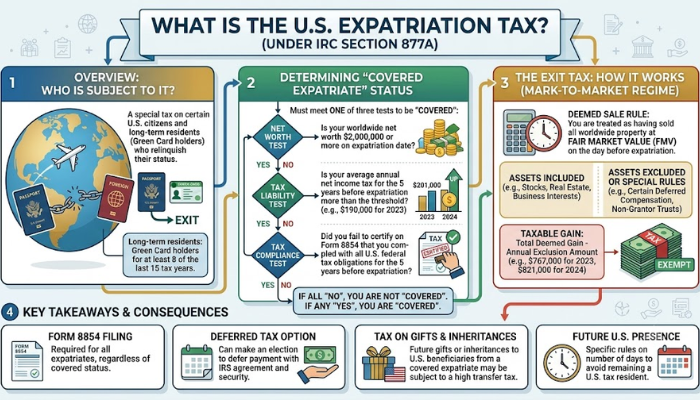
The expatriation tax, often called an exit tax, is a mark‑to‑market levy. The law treats your worldwide assets as if they were sold the day before you renounce. You owe tax on the built‑in gain above an annual exemption, even if you don’t sell anything.
What is the U.S. Expatriation Tax?
Section 877A of the tax code imposes a deemed sale on most property. It taxes net unrealized gains on stocks, real estate, and business interests over a $910,000 exclusion (2026). Special rules apply to certain retirement accounts, but the core principle is a final tax on wealth you built while a U.S. person.
Is Expatriation Tax and Exit Tax Same?
Yes, they are identical. When people search “What is the U.S. expatriation tax?” after hearing “exit tax,” they mean the exact same liability. The IRS uses both names, and no separate exit tax exists.
How Does Expatriation Tax Work?
Imagine a forced sale of everything you own. You calculate the gain on each asset, subtract the $890,000 exclusion, and pay capital gains tax. That is how knowing “What is the U.S. expatriation tax?” turns paper gains into a real bill — even if you hold onto the assets.
Who Pays the US Exit Tax?
Only “covered expatriates” owe the tax. You become one if your net worth is $2 million or more, your average annual tax liability exceeds a set limit, or you fail to certify compliance.
If you’re still wondering “What is the U.S. expatriation tax?” and whether it applies to you, check these tests. Determining your status alone can be tricky — Blueprint Advisors can help you navigate the rules and avoid costly mistakes.
Who is a Covered Expatriate?
A covered expatriate faces the full mark‑to‑market rule. You may encounter the phrase “in lieu of,” so what is the meaning of lieu in income tax? It simply means “instead of” — you pay this one‑time exit tax instead of future U.S. taxes on those gains.
How Much is the US Exit Tax?
The bill depends on your build‑in gain. Don’t confuse it with the info regarding “What is tax yield?” The exit tax is a one‑time capital gains calculation. After subtracting the $890,000 exemption, rates reach 20% plus any net investment income tax. Large investment accounts or real estate can create a substantial liability.
The Bottom Line
Renouncing U.S. status comes with a final tax hurdle. Knowing what is the U.S. expatriation tax before you act can prevent a shocking bill. Covered expatriates owe tax on worldwide gains above the exemption. With early planning, accurate asset valuations, and expert support, you can exit cleanly and avoid unwelcome surprises.