

In today’s global finance, studying international tax compliance is a necessity for individuals and businesses alike. During tax planning, it is natural to think about what is a non-US financial institution.
L&Y Tax Advisors helps you navigate such complex definitions. We ensure your full compliance with the Foreign Account Tax Compliance Act (FATCA) and other regulatory frameworks.
What is a US Financial Institution?
A US Financial Institution (USFI) is an entity. It is organized under the laws of the United States that:
- Accepts deposits
- Holds financial assets for others
- Engages in investment and insurance activities
US financial institutions are regulated by federal and state agencies, such as the
- Federal Reserve Board
- Federal Deposit Insurance Corporation (FDIC)
Therefore, comprehending such monetary aspects is crucial, especially when determining, ‘Is fintech a good career in the USA?’. It is because the intersection of conventional banking and modern technology continues to expand the scope of these entities.
What is a US Financial Institution Example?
Common examples of US financial institutions include:
- Domestic commercial banks (like JPMorgan Chase or Bank of America)
- Credit unions
- US-based brokerage firms
Insurance companies and domestic investment funds also fall under this category.
What is a Non-US Financial Institution?
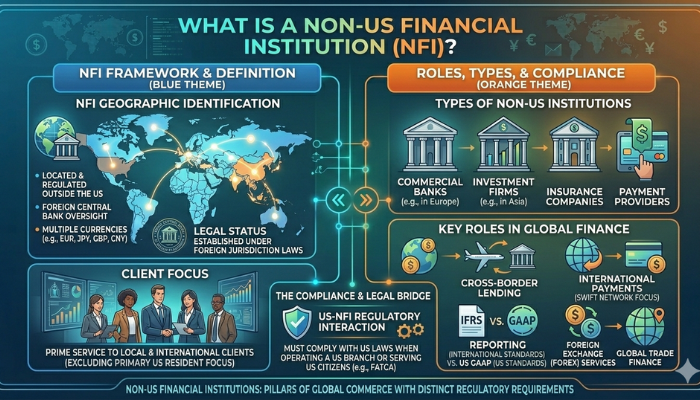
So, what is a non-US financial institution?
Under the IRS guidelines, the non-financial institution was formally known as a Foreign Financial Institution (FFI). It refers to any entity located outside the United States that performs financial activities. This includes
- Banks
- Certain insurance companies
- Investment entities
Identifying what is tax technology helps FFIs automate their reporting processes to the IRS. This is a requirement for any non-US financial institution holding accounts for US persons.
What is a non-US Financial Institution Example?
Typical examples include:
- International banks (like HSBC or Barclays)
- Foreign-based hedge funds
- Private equity firms (located in Europe or Asia)
Any entity that manages portfolios or trades in financial assets outside the US qualifies as a non-US financial institution.
US Financial Institution vs. Non-US Financial Institution
The primary difference lies in the jurisdiction of incorporation and the specific reporting obligations to the IRS. For instance, knowing how to file taxes for forex trading requires identifying whether your platform is a domestic or foreign entity.
| Feature | US Financial Institution (USFI) | Non-US Financial Institution (FFI) |
| Location | Organized within the United States | Organized outside the United States |
| Regulation | Subject to US federal/state laws | Subject to local foreign laws & FATCA |
| Reporting | Standard domestic IRS reporting | Must report US account holders to IRS |
| Tax Withholding | Generally not subject to 30% FATCA tax | Subject to 30% tax if non-compliant |
Does the US Have NBFC?
Yes, the United States has a strong sector of Non-Banking Financial Companies (NBFCs). These are referred to as non-bank financial institutions. These include
- Mortgage lenders
- Peer-to-peer lending platforms
- Insurance companies
Such companies provide monetary services without holding a full banking license.
The Bottom Line
Knowing what is a non-US financial institution is the first step to prevent heavy penalties and ensuring global tax transparency. Whether you are an expat or a business owner, stay updated on these classifications is for your financial health.