
In today’s digitized world, decentralization has shifted from a buzzword to a foundational pillar of global finance. To stay updated about modern trends, business owners think about what exactly is blockchain technology. At its core, this innovation represents a transition from centralized databases to distributed systems; here, transparency and security are paramount.
Whether you are wondering ‘Is fintech a good career in the USA?’ or looking to modernize your business operations, comprehend this digital architecture to navigate the current economic climate.
What is Blockchain in Simple Words?
Imagine a shared digital notebook that everyone in a network can see. But, no one can erase or edit. In this notebook, each page is a ‘block’ that contains data. Once a page is full, it is cryptographically sealed and linked to the previous one, forming a ‘chain.’ Every participant holds an identical copy. Therefore, it eliminates the need for a central middleman to verify information.
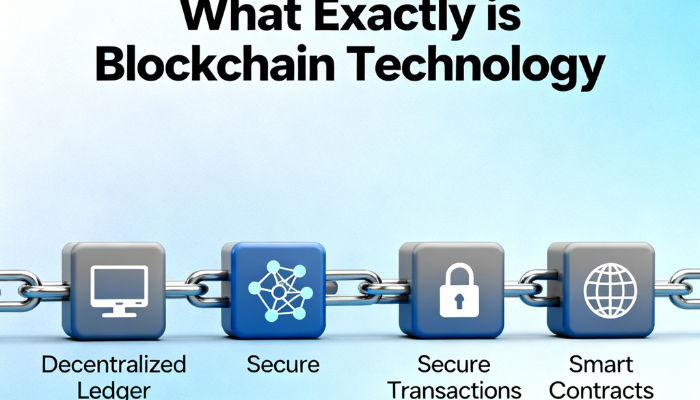
What Exactly is Blockchain Technology?
From a technical standpoint, blockchain technology is defined as a Peer-to-Peer (P2P) distributed ledger technology (DLT). It utilizes consensus mechanisms – such as Proof of Stake (PoS) – to validate transactions. This ensures that every entry is authentic and chronologically ordered without depending on a single governing authority.
Blockchain Example
A practical application is seen in cross-border payments. Traditionally, sending money internationally involves multiple banks and days of waiting. With blockchain, the transaction is recorded on the ledger. Afterwards, it is verified by network nodes instantly. It reduces settlement times to mere seconds. This efficiency is why many professionals now seek to learn how to file taxes for forex trading involving digital assets.
What is the Purpose of Blockchain Technology?
The primary purpose of blockchain technology is to establish ‘trustless’ environments. It prevents fraud and double-spending by providing an immutable record of data. For firms, this technology
- Enhances auditing accuracy
- Streamlines complex record-keeping
Which Popular Cryptocurrency Uses Blockchain Technology?
Bitcoin remains the most prominent example. It is viewed as ‘digital gold.’ However, Ethereum has revolutionized the space by introducing smart contracts – self-executing agreements that further automate business logic.
What are the 4 Types of Blockchain Technology?
The four types of blockchain technology are as follows:
Public Blockchains
Public blockchains are completely decentralized, open-source networks. Anyone can join, read, and write data. They offer high transparency and security. But, they face lower transaction speeds.
Private Blockchains
Private blockchains are restricted networks controlled by a single entity. It makes them faster and more secure for internal business operations, but centralized.
Consortium Blockchains
Consortium blockchains are also known as ‘Federated blockchains.’ These are ‘permissioned’ networks where multiple organizations govern the chain. It provides a balance between trust and decentralization.
Hybrid Blockchains
Hybrid blockchains refer to a blend of public and private features. They offer the security of a private network while allowing authorized public access to certain records.
The Bottom Line
As we integrate more digital assets into our portfolios, knowing what exactly is blockchain technology helps in making informed decisions. As professionals ask what is tax technology to improve compliance, the role of decentralized ledgers will only grow. L&Y Tax Advisors ensures that you are prepared for a transparent, secure, and efficient financial future.