


Industry accounting is essential for monetary supplements. It is vital to the success of any firm. It entails the systematic recording, analysis, and reporting of financial transactions unique to a given industry or sector. But what is industry accounting, and how does it differ from regular or public accounting?
Industry accounting, also known as sector-specific accounting, is the process of customizing accounting systems and financial reporting to meet the unique demands and features of a single business or sector. Every sector has its set of rules, standards, and operational complexities that must be taken into account while conducting financial transactions. Sector-specific accountants are in charge of ensuring that financial records correctly reflect the economic activity of their sector.
Essential Aspects of Industry Accounting
Regulatory agencies impose varied regulations and standards on diverse industries. Accountants in the industry must be familiar with these rules and verify that the financial statements conform to them. For instance, the healthcare business may have special revenue recognition accounting requirements, but the industrial sector may have inventory value criteria.
Expenditures are frequently allocated to different departments, initiatives, or products within a business. This approach assists organizations in understanding the cost structure of their operations and making educated resource allocation decisions.
Each sector has its set of performance indicators essential for determining budgetary health. For example, the retail business may prioritize indicators, such as same-store sales growth, whereas the technology sector may prioritize customer acquisition costs and lifetime value.
Tax laws and regulations differ significantly between industries. CPA services in the industry must guarantee that the firm complies with applicable tax rules and takes advantage of any available tax breaks.
Visit here to get tax consultancy services.
Significance of Industry Accounting
Monetary data relevant to an industry is essential for making informed decisions. Business executives may utilize industry accounting data to examine their company’s financial health, find areas for development, and make strategic decisions to increase profitability.
Compliance with industry-specific legislation and accounting standards is critical for avoiding legal troubles and preserving the company’s reputation. Accountants in the industry play an essential role in maintaining compliance. Practical industrial accounting helps organizations to deploy resources more efficiently. It involves budgeting, investing, and controlling operational expenditures to maximize profitability and growth.
Industry accounting provides methods for analyzing a company’s performance in the context of its industry. Comparing financial indicators to industry standards assists in identifying areas where the organization may thrive or need to improve.
What are industry accounts?
Industrial accounts are business accounts used for managing, tracking, and analysing specific financial information for their industry. These accounts deliver specific information on the company’s financial health and the performance of its specific sector and allow for better analysis and strategic planning.
Key Features of Industry Accounts
- Specific Metrics for Sectors: designed to gather the relevant data for a particular business, for example the turnover of inventory in retail, or the cost of patient care in the field of healthcare.
- Benchmarking: Companies can compare their results against industry benchmarks to benefit them identify areas of improvements.
- Regulation Compliance: Ensures financial practices comply with industry-specific requirements and standards, thus minimizing the risks of compliance.

Benefits of Industry Accounts
- Improved Decision-Making: Management is provided with accurate, relevant, measurable data that can be used to make strategic decisions.
- Increased efficiency: Streamlines financial reporting procedures that are tailored to the needs of the industry.
- Competitive Advantage: Helps companies stay ahead of the curve by studying the latest trends in their industry and establishing their businesses energetically.
Utilizing and understanding the industry’s accounts will significantly improve an organization’s operational efficiency and capacity for strategic planning.
The industry economic accounts, presented both in an input-output framework and as annual output by each industry, provide a detailed view of the interrelationships between U.S. producers and users and the contribution to production across industries. These accounts are used extensively by policymakers and businesses to understand industry interactions, productivity trends, and the changing structure of the U.S. economy.
Emerging Technologies and ESG Reporting in Industry Accounting
With the accelerating digital transformation in 2025, industry accounting will need to cater to new sources of data and demands from stakeholders. Automated data collection, via IOT sensors on manufacturing machinery or blockchain-based supply-chain ledgers, allows for real-time tracking of costs and variances. For instance, a food processing producer can earn automatic calculation of managed energy usage and waste-disposal costs per product line to enhance margin visibility and facilitate leaner operations. Environmental, social, and governance (ESG) reporting has simultaneously become part of industry accounting. Firms of all kinds must now report, alongside financial figures, their greenhouse gas emissions, labour-safety metrics, and data on board diversity.
Accountants will need to incorporate nonfinancial KPIs, like carbon intensity per unit of output or water-use efficiency, into their cost-allocation models and external reporting (somewhat according to models like the ISSB Standards or GRI). With built-in ESG modules, cloud-based accounting platforms make it possible for finance teams to tag transactions by category of sustainability, automatically roll up totals, and produce disclosures that satisfy both investors and regulators. In renewable energy, for example, project accountants monitor capital-expenditure amortization and renewable energy credits in a single ledger, with transparency as to asset performance and ESG impact. The adoption of these technologies and ESG mandates allows industry accounting to transform from a rearward-looking undertaking into a strategic business partner, one that provides forward-looking intelligence to inform innovation, risk management, and sustainable growth.
Get the best Tax Consulting Services here!
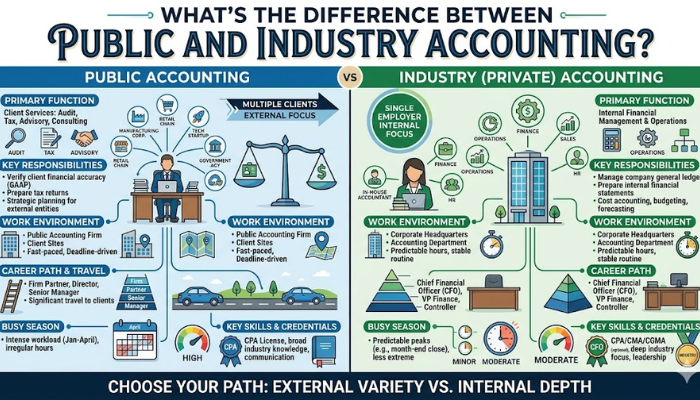
What’s the Difference Between Public and Industry Accounting?
| Features | Public Accounting | Industry (Private) Accounting |
| The core client | You work for an accounting firm. Your “boss” is a portfolio of different companies (clients). | You work for one specific company (e.g., a tech startup, a hospital, or a retailer). |
| Primary mission | Verification. You audit books, prepare taxes, or provide consulting to ensure others are compliant. | Management. You handle the day-to-day finances, internal budgeting, and financial planning for your employer. |
| Work variety | High. You might jump from a manufacturing client on Monday to a non-profit on Thursday. | Focused. You become an absolute expert in the nuances of one specific industry. |
| The ‘Busy’ season | Intense. From January to April, 60–80 hour weeks are the standard “baptism by fire.” | Predictable. Peaks usually hit during month-end, quarter-end, or annual budget season. |
| Career trajectory | Fast-paced. It’s “up or out.” You move from Staff to Senior to Manager on a relatively set timeline. | Variable. Growth often depends on company expansion or when someone above you leaves. |
| Travel | Frequent. You’re often at client sites (though remote auditing has increased). | Minimal. You generally work from a central office or a fixed home setup. |
| Credentials | A CPA is often non-negotiable for advancement past a certain level. | Highly valued, but experience and niche certifications (like a CMA) also carry weight. |
The Bottom Line
Understanding what is industry accounting is critical in the financial administration of firms in various sectors. Our CPA Woodlands TX offers organizations the financial information they need to make educated choices, maintain regulatory compliance, allocate resources efficiently, and evaluate performance by adjusting accounting procedures and financial reporting to industry-specific demands. Industry accounting is critical for the implementation and sustainability of firms in any sector in a continually changing business landscape.